
Product Review - Handheld GPS Sat Nav

|
Product Review - Handheld GPS Sat Nav |
|
|
|
GPS Sat Nav Review Update of the Garmin etrex LegendUpdate Oct 2006 - one year on. Living with our GPS Sat Nav receiver.See this article's main
sat nav review This page should now be considered an archive resource (although the principles may still apply).
To start on a positive note, we've largely solved the short battery life problem with the purchase of some higher capacity NiMh cells. We easily get a day's usage now using 2100 mAh capacity batteries, although we still can't understand why the Sat Nav receiver consumes so much power. The GPS receiver has proved to be a robust little unit, as we've dropped it a least twice onto hard tarmac and all it suffered were some minor abrasions. However, that brings us to the first bad point. The reason we dropped it in the first place on one occasion was because the battery cover attachment clip came undone. As this clip also doubles as the eyelet for the lanyard attachment, the unit dropped to the ground - with battery cover still attached to our wrist via the lanyard! The clip turns through 90 degrees to attach and it easily comes undone, a more robust clip or, better still, an attachment for the lanyard on the main unit would be a better design. We've been unable to solve the poor integration with the Basemap, despite tinkering with the magnetic variation setting and Map Datum. We've also looked for a software upgrade that may solve this problem, but there hasn't been one from Garmin since we brought the Sat Nav receiver over a year ago. Come on Garmin! The problem with poor GPS satellite reception in the city or wooded areas remains too. On a visit to London we couldn't get a GPS signal in the West End at all, until we moved into Hyde Park, then it was fine. The same problem with no signal was apparent at Cheddar Gorge when climbing Jacobs Ladder. And on another occasion we thought the unit had failed as it couldn't latch onto any signal at all for several hours, this under heavy cloud cover, but hey, clouds are not that unusual!
Left. Wow, just see here how fit we are! The Trip Computer says we've walked 264 miles in 1hr 21mins at an average of 194mph while all along our top speed was 9.1mph (that in itself is an impossibility walking!). Now to finish our update on a more positive note. During our weekend break in Arundel early in 2006 we noticed it reporting a higher accuracy - to within 4 meters sometimes. So maybe the promised GPS correction system satellites in Europe (EGNOS) are now coming online? Our main use for the Sat Nav is to assist with finding a different way back to where we started a walk and using the GoTo function to navigate to a pre-determined (projected) waypoint, giving us the miles countdown and destination ETA. For these uses the Sat Nav unit is fine, if a bit limited by the number of routes and tracks it can store and subject to it receiving a solid satellite signal.
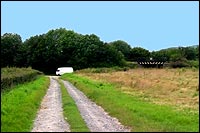
Update Aug 07 - two years on - and a spooky sat nav story! The problem with the Sat Nav receiver being unable to get a GPS satellite signal under heavy cloud, tree or city buildings remain, frustratingly this is the time you probably need it the most! We're sick of seeing the message 'poor signal, need clear view of the sky' - godammit, it's got a clear view of the sky! Another thing to report is that the left top most button - used to zoom out on the map - seems to require a firmer pressing than the others and we think it's become more recessed too. This is worrying as it doesn't get excessive use. If this indicates a looming mechanical failure with our Sat Nav unit, that would certainly be unacceptable in such a short time. We discovered an issue with the navigate a route feature. One day we attempted to use the GoTo to navigate to a projected waypoint we'd set, but appeared to have no GPS satellite signal for the whole journey (horror, we had to use... a map!...). We thought the Sat Nav receiver had failed, but later realised it was still set to navigate a previous route. So the unit just refused to acknowledge a signal when confronted with this conflict. No error message, it just gave up. A software upgrade would probably fix this, but still none have been forthcoming for the etrex Legend from Garmin. The Sat Nav receiver is said to withstand immersion in water. We've never tested this, but we did have a problem with the display misting up when using the unit in warm sunshine a week after previously using it in drizzle. So it had clearly gotten damp inside. Although this quickly cleared up of its own accord, nevertheless we wouldn't want to test the water immersion capability! Now, the spooky sat nav story... The GPS Sat Nav locations may be accurate, but we're still plagued by the inaccurate Basemap. The photos (or rather video stills) below illustrate just how hopeless this is, from a walk we did along The Shropshire Way on holiday in 2007. Notice the road and railway line seem to be the wrong way round too, were going to hit the road first.
One final point on waypoint accuracy. We often enter
into the Sat Nav a GPS coordinate obtained from a postcode (eg using Multimap), and did
so to locate our 2007 Shropshire
holiday cottage. Usually this pinpoints a location fairly
accurately. However, on this occasion the GPS position was some
200 meters to the South West of the actual cottage. It's probably
an issue with the postcode system rather than GPS, but something to be
aware of.
Update Sept 08 - three years on - and our GPS unit is still
going strong!
There's only been one new issue that's manifested itself with our Sat Nav unit since last year's update. This is the Sat Nav receiver's rubberised surround oozing glue when it gets hot, eg on the car dash or left too long in the sun on a walk. (Err, what sun? The last two summers have been washouts!). Still the Basemap doesn't tally with our location and still no software update from Garmin. When the time comes to replace our GPS receiver, this situation will undoubtedly cause us to look at other brands. We'll also go for a colour screen next time as we find the display difficult to follow. In fact, we've been considering what to replace our Garmin GPS Sat Nav receiver with and decided a PDA or Palmtop type unit would be more suited to our needs, especially as we're into Geocaching now and web access, a photo store and making notes electronically while on the move would be really useful features.
Update Sept 09 - four years on - a software update at
last! And increased accuracy! Another useful thing we've done is to integrate the unit with Google Earth and transfer our saved routes, tracks and waypoints - which then show up in 'Places' and added as a map layer. This has confirmed our ongoing issue with the unit's Basemap, namely that it's very inaccurate, as our locations and tracks show up spot-on on Google Earth. We've had a few problems since our last update. Last time we mentioned the rubberised surround was oozing glue. Well, this surround is now quite loose and unstuck. Another problem was when the receiver locked up, displaying a pulsating, flashing display which we blamed on a low or iffy battery connection, but sorting this and even resetting (sw off/on) didn't fix it. The next time we used it it was fine, so this remains a mystery. And another problem is the display sometimes blanks out when the backlight is activated which isn't very helpful. On our previous update we hinted at a replacement. In fact, in the summer we did look at Pocket PCs and mobile devices and did a fair bit of research but couldn't come up with a unit that met all our desired requirements. Then our fridge/freezer packed up (while away on our Cotswold holiday) so we had to re-allocate our earmarked funds. Maybe next year...
Update Oct 2010 - five years on - and the craziest readings
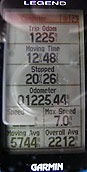
ever! A new problem manifested itself in the last year - a dodgy click-stick (that's the little joystick on the front of the Garmin used to navigate around the device). It doesn't always register when moving side to side or clicking in; we suspect the contacts within becoming worn, which is worrying considering the click stick is fundamental to operation. Continuing problems are the ongoing flashing/pulsating/blanking display and rubber surround coming adrift as previously highlighted. We've not found any further software updates from Garmin, nor do we expect to given the age of this GPS Sat Nav unit now. Pics of our Garmin etrex Legend's trip computer screen. Left: 112 miles in only 18 minutes at a max speed of 1743 MPH! And on the right we've covered a whopping 1225 miles at an average 5744 MPH in only 12 minutes while hitting a measly max of 7 MPH this time! (Um, sorry about the screen reflections - pics taken on the hop at the time). We'll probably make this brief update the final one for our handheld GPS product which is now five years old and past its prime, both operationally and technically. As hinted in our previous updates we're looking to replace it with a smartphone type device with Sat Nav function - Mike has his eyes on HTC and Android - which we'll review in due course!
Update Oct 11 - six years on - OK, one more update then. Something else strange was when the unit couldn't find any satellites one day and reported 'poor satellite reception, use with GPS off'. OFF? Come on, the whole point was to navigate! This happened on the way to do a spot of Geocaching and with a wide clear view of a clear sunny sky. Rebooting didn't rectify it and all settings looked normal. Then miraculously just before reaching our target area it decided to work! Could the GPS system itself have gone down? Who knows, but it's been fine ever since. And on our Isle of Wight holiday yet another strange thing happened when the batteries (rechargeable AA size) refused to fit despite using them many times previously. It was like they'd grown longer! In fact, it bent the battery contacts necessitating a 'field-fix'. On closer inspection when back home we discovered that indeed they had got marginally longer, following getting cooked when we left them in the re-charger for far too long (it also wrecked the battery's ability to hold a charge). Learning from this, we got a charger that cuts off when fully charged! No more ridiculous readings to report this time, and we still haven't stuck down the rubber surround which still comes adrift in hot weather. We still intend to replace this unit with a smartphone... sometime.
Update Oct 2012 - the seven year itch? See the main GPS receiver review.
You can find the Garmin website at: www.garmin.com/en-GB © micbinks 2006-2012. Please ask permission if you wish to reproduce any of our content. View our Dorset holiday pages where we first used this product. |
||||||||||
|
|
|||||||||||

 Since we wrote our GPS review article a year
has passed. In that time we've used our GPS Sat Nav receiver on
many trips and outings - weekend breaks in the
Since we wrote our GPS review article a year
has passed. In that time we've used our GPS Sat Nav receiver on
many trips and outings - weekend breaks in the 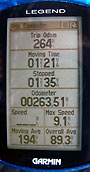 On a number of occasions the
GPS Sat Nav receiver reported silly data on the Trip Computer page -
recording 106 miles and an average speed of 56 mph on a short walk (and
we thought it was the hill that puffed us!). Another time was
even more ridiculous when it said we'd done 619 miles, hit 622 mph and
a moving average of 317 mph! Now Mike's car's fast, but not that
fast! Crazy!
On a number of occasions the
GPS Sat Nav receiver reported silly data on the Trip Computer page -
recording 106 miles and an average speed of 56 mph on a short walk (and
we thought it was the hill that puffed us!). Another time was
even more ridiculous when it said we'd done 619 miles, hit 622 mph and
a moving average of 317 mph! Now Mike's car's fast, but not that
fast! Crazy!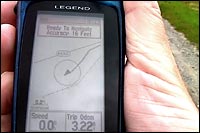

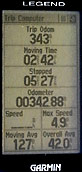 Right. Although
we've only maxed 4.9 MPH we've covered 343 miles in 2hr 42mins at an
average 127 MPH! Mike's been wearing his superhero underpants on
the outside of his jeans again!
Right. Although
we've only maxed 4.9 MPH we've covered 343 miles in 2hr 42mins at an
average 127 MPH! Mike's been wearing his superhero underpants on
the outside of his jeans again!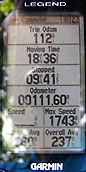
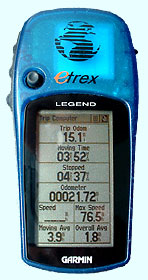
 First, those
crazy readings - just have a look at our photos of the Garmin's Trip
Computer page! And we all thought a Concord successor wasn't in
development!
First, those
crazy readings - just have a look at our photos of the Garmin's Trip
Computer page! And we all thought a Concord successor wasn't in
development!